Biggest Problems With Electric Cars
Promoting the Worst Car Niches
BEV competitiveness spans a broad range. In some niches, BEVs offer an attractive solution. In others, they will never be competitive. And here’s the problem: The niches where BEVs make the most sense are those that bring out the worst of the car.
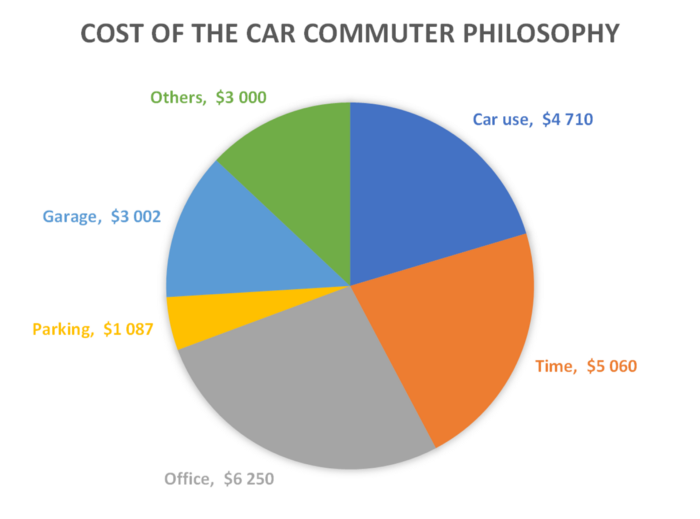
The first of these niches is the suburban commuter, where a BEV with a relatively small battery pack is a compelling solution (especially for two-car families). I updated my earlier estimate of the total societal costs of the car commuter philosophy and arrived at a whopping $23,100/year (see below). This is about half the average wage of rich-world citizens. If we assume a worker creates about twice as much value as his salary, it means that about a quarter of the value created by the average commuter is instantly destroyed by the (stressful and frustrating) model of getting to work.
Other forms of urban car transport are no better. Consider one of the most iconic symbols of a car-centered society: the supermall. People haul their 2.5-ton SUVs many miles to this structure to go and pick up 0.05 tons of stuff (much of it being wasteful impulse buys). Another highly ironic use-case for the urban SUV is burning 15,000 kcal of fuel to go and burn 500 kcal of fat by running like a hamster on a treadmill in a distant gym.

Then, we have the stereotypical “soccer mom” who spends her days as a children’s chauffeur. In an efficient society where kids can freely move around by foot or bicycle, our soccer mom could be doing so many more useful and fulfilling things with her life than stifling her children’s independence. Unfortunately, this ultra-inefficient model is often the only option in car-centered societies as distances are so vast and walking/cycling is too dangerous (partly due to all the other soccer moms in oversized SUVs distracted by their frustrated kids fighting in the back.)
The luxury car segment also deserves a special mention. BEVs work in this segment because the cost of a large battery pack is moderate relative to all the bells and whistles on a luxury car (the quiet performance of electric drive also fits the luxury image). But while urban cars are a highly inefficient part of society, luxury urban cars ramp up the inefficiency by several additional notches. They provide essentially the same service for a lot more money and don’t even make their owners happier.
Thus, BEVs not only promise to perpetuate the inherent inefficiency of car-centered cities; they also naturally promote the niches where cars cost society the most dearly.